
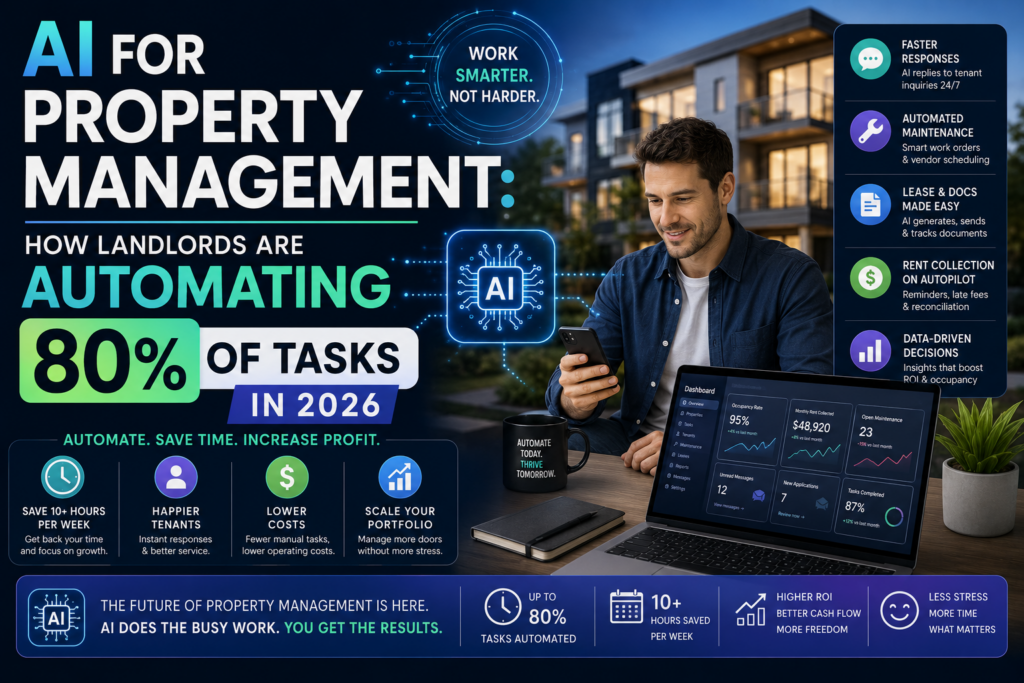
AI for Property Management: How Landlords Are Automating 80% of Tasks in 2026
Property Management Is No Longer Manual
For years, property management has been:
- Reactive
- Time-consuming
- Dependent on manual processes
That’s changing — fast.
In 2026, landlords are no longer managing properties the same way.
They’re automating the majority of their operations using AI.
Not as a gimmick.
As a competitive advantage.
This guide breaks down how it works — and where it actually makes an impact.
What “AI in Property Management” Actually Means
It’s Not Robots — It’s Systems
AI in property management isn’t about replacing people.
It’s about:
- Automating repetitive tasks
- Improving decision-making
- Reducing human error
Think:
- Faster responses
- Smarter pricing
- More efficient operations
The Goal Is Efficiency, Not Complexity
The best systems:
- Simplify workflows
- Remove bottlenecks
- Increase consistency
AI isn’t adding work — it’s removing it.
Where AI Is Already Replacing Manual Work
Leasing and Tenant Communication**
AI tools now handle:
- Initial inquiries
- FAQ responses
- Scheduling showings
This eliminates hours of back-and-forth communication.
Tenant Screening**
AI-assisted systems can:
- Analyze applications faster
- Flag risk factors
- Standardize decision criteria
This reduces both time and risk.
Rent Collection and Reminders**
Automation handles:
- Payment reminders
- Late notices
- Tracking payments
No manual follow-ups required.
Maintenance Requests**
Tenants can:
- Submit issues digitally
- Get automated responses
- Be routed to the right vendor instantly
This speeds up resolution and improves tenant satisfaction.
How AI Improves Rental Income
Smarter Pricing Decisions**
AI can analyze:
- Market rent trends
- Demand fluctuations
- Competitor listings
This allows landlords to price units more accurately.
Reduced Vacancy Time**
Faster:
- Response times
- Listing optimization
- Leasing processes
Lead to shorter vacancies.
Better Tenant Retention**
Consistent communication + faster service =
- Higher satisfaction
- Longer tenancies
Which directly improves ROI.
The 80% Rule — What Gets Automated
In 2026, most high-performing landlords automate:
- Tenant inquiries
- Scheduling
- Payment processing
- Maintenance workflows
- Reporting
What remains manual:
- Strategic decisions
- Relationship management
- Portfolio growth
AI handles the repetitive — humans handle the important.
H2: Real-World Use Cases
24/7 Inquiry Response**
Instead of waiting hours (or days), tenants get immediate replies.
Impact:
- More leads captured
- Faster leasing
- Better experience
Automated Follow-Ups**
No missed opportunities.
Every inquiry gets:
- A response
- A follow-up
- A next step
Predictive Maintenance**
AI can identify patterns:
- Frequent repair issues
- Equipment lifecycle trends
This allows for proactive fixes instead of reactive costs.
Common Misconceptions About AI in Property Management
“It’s Too Expensive”**
In reality:
- Most tools are scalable
- Cost is often offset by efficiency gains
“It’s Too Complicated”**
Modern systems are:
- User-friendly
- Integrated
- Designed for non-technical users
“It Replaces the Human Element”**
The opposite is true.
AI handles routine tasks, allowing landlords to:
- Focus on higher-value interactions
- Improve tenant relationships
Where Most Landlords Fall Behind
The gap isn’t access to AI — it’s implementation.
Common issues:
- Using disconnected tools
- Not fully automating workflows
- Relying on manual processes out of habit
The result:
- Slower operations
- Higher costs
- Lower returns
The Role of Property Management in AI Adoption
This is where execution matters most.
A strong property management system:
- Integrates AI tools seamlessly
- Automates end-to-end workflows
- Ensures consistency across properties
Without structure, AI becomes just another tool — not a solution.
Benefits Beyond Efficiency
Scalability**
AI allows landlords to:
- Manage more properties
- Without increasing workload
Consistency**
Every tenant gets:
- The same response time
- The same experience
- The same process
Data-Driven Decisions**
Better data leads to:
- Better pricing
- Better planning
- Better outcomes
Risks of Not Adopting AI
Landlords who stay manual face:
- Slower leasing
- Higher vacancy rates
- Increased workload
- Reduced competitiveness
In 2026, efficiency is no longer optional.
What to Look for in an AI-Driven Property Management System
Key features:
- Automated communication
- Integrated payment systems
- Maintenance tracking
- Data analytics
- Centralized dashboards
The goal is one system, not multiple tools.
Key Takeaways
- AI is already transforming property management
- 70–80% of tasks can be automated
- Faster processes = higher income
- Tenant experience improves with automation
- The advantage comes from implementation, not access
Conclusion: The Future of Property Management Is Already Here
This isn’t a future trend — it’s a current shift.
The landlords who adopt early:
- Operate more efficiently
- Scale faster
- Earn more
Those who don’t:
- Spend more time
- Miss opportunities
- Fall behind
The difference is no longer effort — it’s systems.