
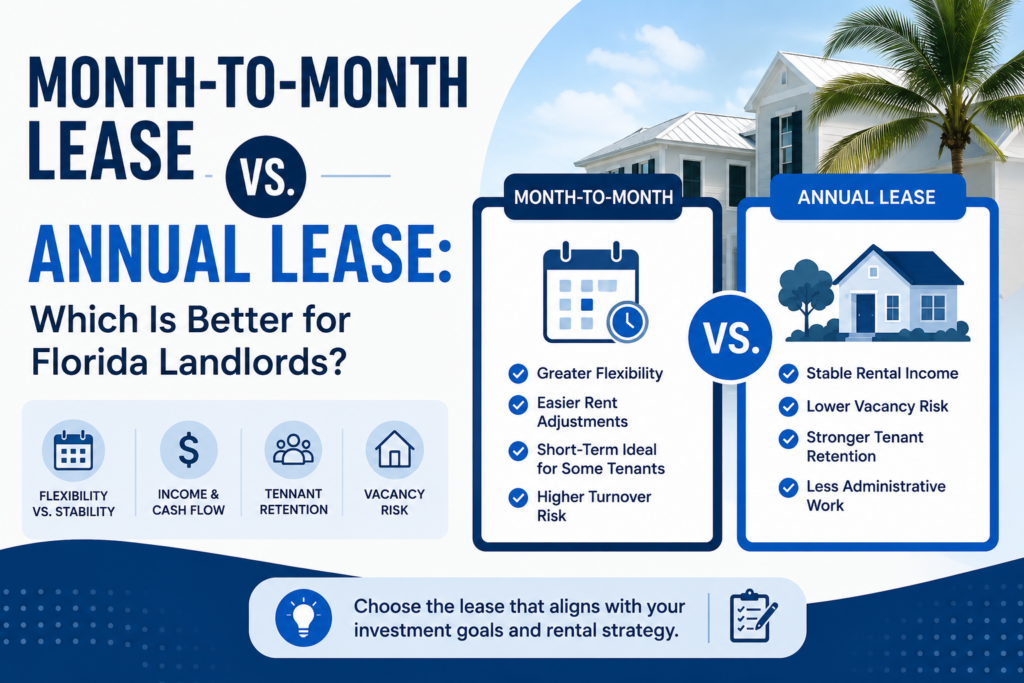
Month-to-Month Lease vs. Annual Lease: Which Is Better for Florida Landlords?
One of the biggest decisions landlords make isn’t choosing the right tenant—it’s deciding how long the lease should be.
Should you offer a traditional one-year lease?
Or would a month-to-month agreement provide more flexibility?
The answer isn’t always straightforward.
Each option has advantages and disadvantages, and the right choice depends on your investment goals, the local rental market, tenant demand, and how involved you want to be in managing your property.
Many first-time landlords assume that a 12-month lease is always the better option, while others believe month-to-month agreements give them greater control. In reality, both lease structures can be excellent choices under the right circumstances.
Understanding the differences can help you reduce vacancies, improve cash flow, increase tenant retention, and protect your investment over the long term.
This guide compares month-to-month leases and annual leases, explains when each option makes sense, and helps Florida landlords make smarter leasing decisions.
What Is a Month-to-Month Lease?
A month-to-month lease automatically renews every month until either the landlord or tenant decides to end the agreement according to the lease terms and applicable Florida law.
Unlike a fixed-term lease, there is no predetermined end date.
This type of lease offers flexibility for both parties.
Month-to-month leases are commonly used when:
- A tenant is relocating soon.
- A landlord plans to sell the property.
- Temporary housing is needed.
- The future availability of the property is uncertain.
- A fixed lease has expired and both parties continue the tenancy.
What Is a Fixed-Term Lease?
A fixed-term lease, commonly lasting 12 months, establishes a rental agreement for a specific period.
During the lease term:
- Monthly rent remains consistent unless otherwise agreed.
- The tenant agrees to remain for the lease period.
- The landlord agrees to provide housing under the lease terms.
Annual leases remain the most common rental agreement because they provide stability for both landlords and tenants.
Month-to-Month Lease vs. Annual Lease
| Feature | Month-to-Month | Annual Lease |
| Lease Length | Renews monthly | Fixed term (typically 12 months) |
| Flexibility | High | Lower |
| Tenant Stability | Lower | Higher |
| Vacancy Risk | Higher | Lower |
| Administrative Work | More frequent | Less frequent |
| Rent Adjustments | More flexibility | Typically fixed during lease |
| Long-Term Planning | Less predictable | More predictable |
Each lease structure offers unique advantages depending on the situation.
Advantages of an Annual Lease
Predictable Rental Income
One of the biggest benefits of a fixed-term lease is consistent cash flow.
Knowing that rent is contractually expected for the duration of the lease makes financial planning much easier.
This stability helps landlords manage:
- Mortgage payments
- Property taxes
- Insurance premiums
- Maintenance budgets
Predictable income is especially valuable for landlords with multiple investment properties.
Lower Vacancy Rates
Vacancies are expensive.
Each vacant month can result in:
- Lost rental income
- Cleaning expenses
- Repairs
- Marketing costs
- Leasing commissions
Annual leases naturally reduce tenant turnover, which helps minimize vacancy.
Reduced Administrative Work
Every new tenant requires:
- Marketing
- Property showings
- Applications
- Background checks
- Lease preparation
- Move-in inspections
Longer leases reduce how often landlords repeat these tasks.
Stronger Tenant Relationships
Long-term tenants often:
- Become more familiar with the property.
- Report maintenance issues earlier.
- Take better care of the home.
- Feel more invested in the property.
Longer tenancies often benefit both parties.
Advantages of a Month-to-Month Lease
Greater Flexibility
A month-to-month lease provides flexibility that annual leases cannot.
Landlords may appreciate this when:
- Planning renovations.
- Selling the property.
- Moving into the home themselves.
- Adjusting rental strategies.
Flexibility can be valuable during changing market conditions.
Easier Rent Adjustments
Rental markets change.
In rapidly growing markets, landlords may prefer shorter lease terms that allow rent adjustments more frequently, subject to applicable laws and lease requirements.
This flexibility helps keep rental rates aligned with market conditions.
Better for Temporary Tenants
Some renters specifically seek short-term housing.
Examples include:
- Traveling professionals
- Corporate relocations
- Medical professionals
- Individuals building a home
- Seasonal residents
Offering month-to-month agreements may attract these tenants.
Disadvantages of Month-to-Month Leases
Despite the flexibility, month-to-month agreements also present challenges.
Increased Vacancy Risk
Because tenants can move more easily, landlords may experience:
- More frequent turnovers
- Additional marketing costs
- More cleaning and repairs
- Less predictable income
Frequent vacancies can reduce annual profitability.
More Administrative Work
Higher turnover means more time spent:
- Advertising
- Scheduling showings
- Screening applicants
- Preparing leases
This workload can become significant for landlords managing multiple properties.
Less Financial Predictability
Budgeting becomes more difficult when tenant turnover is unpredictable.
Landlords may struggle to forecast annual rental income.
Disadvantages of Annual Leases
Annual leases also have drawbacks.
Less Flexibility
If circumstances change, landlords may have fewer options during the lease period.
Examples include:
- Selling the property
- Occupying the home personally
- Major renovations
Planning becomes more important.
Longer Commitment to Problematic Tenants
If a tenant becomes difficult but continues complying with the lease, the landlord generally remains bound by the lease agreement.
This makes thorough tenant screening especially important.
Which Lease Type Makes More Money?
Many landlords assume month-to-month leases automatically generate higher profits because rents can be adjusted more often.
However, profitability depends on several factors.
Annual leases may produce:
- Lower turnover costs
- Fewer vacancies
- More predictable income
Month-to-month leases may offer:
- Greater pricing flexibility
- Higher rental rates in some situations
Ultimately, minimizing vacancy often has a greater financial impact than increasing rent by a small percentage.
Factors to Consider Before Choosing
Before deciding on a lease structure, consider:
Property Location
High-demand markets may support shorter lease terms.
More stable residential neighborhoods often benefit from annual leases.
Tenant Type
Families often prefer annual leases.
Temporary workers may prefer month-to-month agreements.
Understanding your target tenant helps determine the best option.
Investment Goals
Ask yourself:
- Am I seeking long-term stability?
- Do I plan to sell soon?
- Is flexibility important?
- Am I building a long-term rental portfolio?
Your goals should guide your leasing strategy.
Tips for Reducing Vacancy Regardless of Lease Type
No matter which lease structure you choose, reducing vacancy should remain a priority.
Best practices include:
- Price the property competitively.
- Respond quickly to inquiries.
- Maintain the property.
- Communicate with tenants.
- Conduct preventative maintenance.
- Offer online rent payments.
- Complete repairs promptly.
Happy tenants are more likely to renew.
Common Mistakes Landlords Make
Many landlords unintentionally reduce profitability by making avoidable mistakes.
Common examples include:
Choosing a Lease Based Only on Rent
Rental income is important, but vacancy costs often have a greater impact.
Ignoring Market Conditions
Rental demand changes.
Review market trends before renewing leases.
Failing to Screen Tenants Thoroughly
A longer lease with the wrong tenant can become more expensive than several shorter leases.
Tenant quality always comes first.
Waiting Too Long to Discuss Renewal
Begin renewal conversations well before the lease expires.
Early communication improves retention.
How Professional Property Management Helps
Professional property managers evaluate market conditions before recommending lease structures.
Services often include:
| Service | Benefit |
| Market Rent Analysis | Competitive pricing |
| Lease Preparation | Professional documentation |
| Tenant Screening | Better tenant selection |
| Renewal Management | Higher retention |
| Vacancy Marketing | Faster leasing |
Property managers can help landlords choose the lease strategy that aligns with both market conditions and long-term investment goals.
Frequently Asked Questions
Is a 12-month lease better than month-to-month?
It depends on your investment objectives. Many landlords prefer annual leases for stability, while others value the flexibility of month-to-month agreements.
Can a month-to-month lease become an annual lease?
Yes. Many landlords begin with one lease type and transition to another if both parties agree.
Which lease type reduces vacancy?
Annual leases typically result in fewer vacancies because tenants remain longer.
Can rent be adjusted more frequently with month-to-month leases?
In many situations, shorter lease terms provide greater flexibility for future rent adjustments, subject to applicable laws and notice requirements.
What do most landlords choose?
Many residential landlords prefer annual leases because they provide predictable income and lower turnover, though the best choice depends on the property’s location and the owner’s goals.
Final Thoughts
There is no universal “best” lease.
The right choice depends on your property, your market, and your long-term investment strategy.
For landlords seeking:
- Stable income
- Lower vacancy
- Less administrative work
An annual lease is often the better option.
For landlords seeking:
- Flexibility
- Short-term opportunities
- Frequent market adjustments
A month-to-month agreement may be more appropriate.
The most successful landlords don’t simply choose the longest lease they choose the lease that best supports their financial goals while meeting the needs of qualified tenants.
By understanding the strengths and limitations of each option, you can make informed leasing decisions that improve occupancy, strengthen cash flow, and maximize the long-term value of your rental property.