
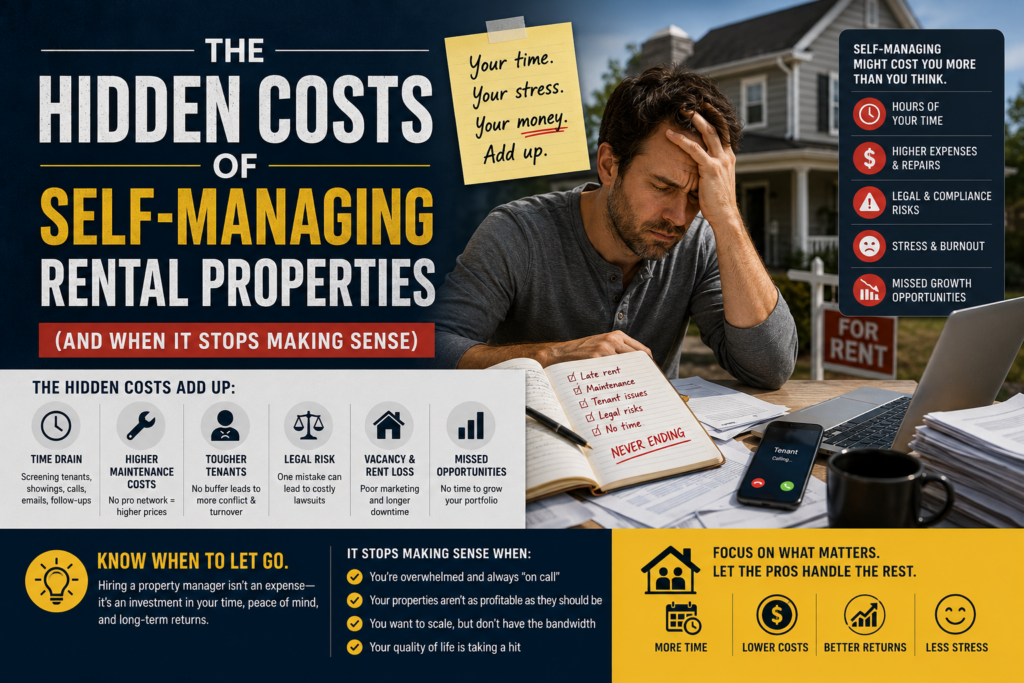
The Hidden Costs of Self-Managing Rental Properties (And When It Stops Making Sense)
Self-Managing Looks Cheaper — Until You Do the Math
On paper, self-managing your rental property seems like the smarter financial move.
No management fees.
Full control.
More profit.
But that’s only true if you ignore the hidden costs.
Because in reality, most landlords don’t lose money on obvious expenses — they lose it in:
- Time
- Inefficiency
- Vacancy
- Mistakes
And those costs add up quickly.
This guide breaks down the real cost of self-management — and when it stops making sense.
The Biggest Misconception About Self-Management
“I’m Saving 8–10% in Management Fees”
This is the most common argument.
But what gets overlooked:
- Lost time has value
- Mistakes have cost
- Inefficiencies reduce income
Saving 10% doesn’t matter if you’re losing 20% somewhere else.
The Real Question Isn’t Cost — It’s Performance
The better question is:
Are you actually maximizing your property’s potential?
Because if the answer is no, then self-management is already costing you.
Hidden Cost #1 — Your Time (The Most Expensive One)
Self-Managing Is a Second Job
Tasks include:
- Responding to inquiries
- Scheduling showings
- Handling maintenance
- Collecting rent
- Managing tenant issues
This easily adds up to 10–20+ hours per month per property.
Time Has Opportunity Cost
What could you be doing instead?
- Acquiring more properties
- Growing your income elsewhere
- Scaling your portfolio
Time spent managing is time not spent growing.
Hidden Cost #2 — Vacancy Loss
Longer Vacancies Kill Profit
Most self-managed properties take longer to fill.
Why:
- Slower response times
- Limited showing availability
- Less optimized listings
Even a 2-week delay impacts annual returns.
Poor Marketing = Lower Tenant Quality
Without professional marketing:
- Fewer qualified applicants
- More screening risk
- Higher turnover
Which leads to more vacancies over time.
Hidden Cost #3 — Pricing Mistakes
Underpricing Costs You Monthly**
Many landlords:
- Set rent based on guesswork
- Avoid adjusting with market changes
Result: consistent underperformance.
Overpricing Leads to Vacancy**
On the flip side:
- Overpricing increases time on market
- Leads to longer vacancies
Both scenarios reduce total income.
Hidden Cost #4 — Tenant Turnover
Turnover Is Expensive**
Each turnover can cost:
- Cleaning and repairs
- Marketing and leasing
- Lost rent during vacancy
This can easily reach one full month of rent or more.
Retention Requires Systems**
Good tenants stay when:
- Communication is smooth
- Maintenance is handled quickly
- Experience is consistent
Most self-managed setups lack these systems.
Hidden Cost #5 — Maintenance Inefficiency
Emergency Repairs Cost More**
Without proactive maintenance:
- Issues escalate
- Repairs become urgent
- Costs increase
Vendor Pricing Isn’t Optimized**
Professional managers often have:
- Established vendor relationships
- Better pricing
- Faster service
Self-managing landlords typically pay more.
Hidden Cost #6 — Legal and Compliance Risk
Laws Are Changing Constantly**
Landlord-tenant laws vary and evolve.
Mistakes in:
- Lease agreements
- Evictions
- Deposits
Can lead to serious financial consequences.
One Mistake Can Erase a Year of Profit**
Legal missteps aren’t frequent — but when they happen, they’re expensive.
Hidden Cost #7 — Scaling Limitations
Self-Management Doesn’t Scale Well**
Managing 1–2 properties is manageable.
Managing 5–10+ becomes:
- Time-consuming
- Complex
- Inefficient
Growth Requires Systems**
Without systems, growth leads to:
- Burnout
- Mistakes
- Reduced performance
When Self-Managing Actually Makes Sense
To be clear — self-management isn’t always wrong.
It can make sense if:
- You have 1–2 properties
- You have time availability
- You’re experienced in leasing and operations
- You’re not focused on scaling
For some landlords, it works — temporarily.
When It Stops Making Sense
You Own Multiple Properties
More units = more complexity.
You Value Your Time
If your time is better spent elsewhere, self-management becomes inefficient.
Your Property Isn’t Performing Optimally
Signs include:
- Frequent vacancies
- High turnover
- Lower-than-market rent
- Constant issues
You Want to Scale
Growth requires:
- Systems
- Efficiency
- Consistency
Self-management often becomes the bottleneck.
The Real ROI of Property Management
It’s Not About Cost — It’s About Net Performance**
A good property management system:
- Reduces vacancy
- Optimizes pricing
- Improves retention
- Lowers operational costs
The goal isn’t to spend less — it’s to earn more overall.
The Best Landlords Think Like Investors**
They focus on:
- ROI
- Efficiency
- Scalability
Not just minimizing expenses.
What Most Landlords Realize Too Late
Many landlords switch to property management only after:
- Experiencing burnout
- Losing money from vacancies
- Dealing with difficult tenants
- Making costly mistakes
By then, they’ve already paid the price.
Key Takeaways
- Self-managing isn’t free — it has hidden costs
- Time is one of the biggest expenses
- Vacancy and turnover reduce profit quickly
- Poor systems limit growth
- Property management is about performance, not just cost
Conclusion: The Decision Isn’t About Saving Money — It’s About Maximizing It
Self-managing can work — for a while.
But as your portfolio grows, so do the inefficiencies.
At a certain point, the question changes from:
“Can I manage this myself?”
To:
“Is this the best use of my time and resources?”
That’s where the shift happens.